


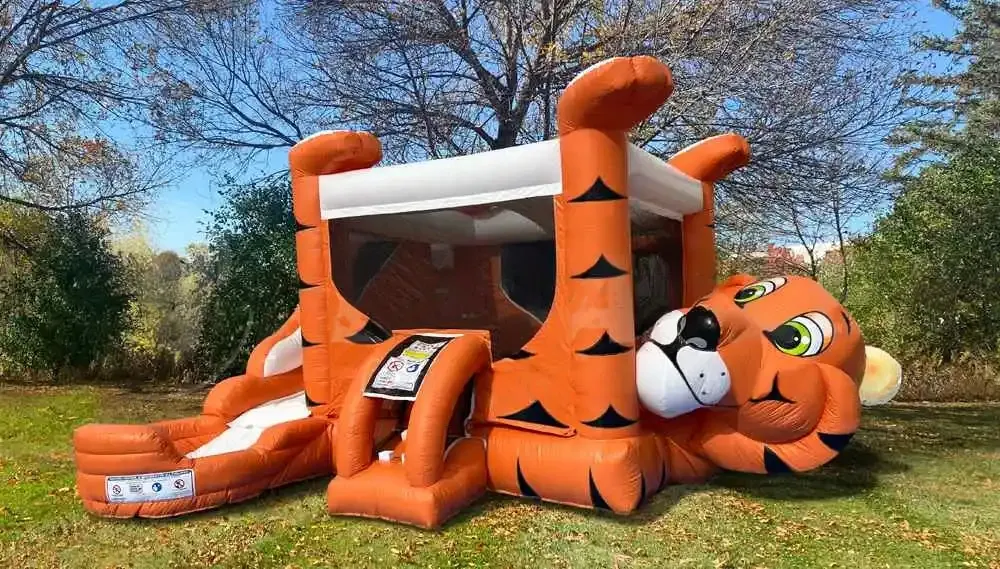
How to Start a Bounce House Rental Business in 2026
The complete playbook for launching an inflatable rental business: licensing, insurance, first units, pricing, and the operational habits that separate the operators who last from the ones who quit by August.
People ask us how to start a bounce house rental business more than they ask us any other question that is not about a booking, and the honest answer is encouraging: this remains one of the most accessible service businesses in America. The startup cost is modest by small business standards, the demand is genuinely recurring because children keep having birthdays no matter what the economy does, and the skills involved are learnable in a season. What the business is not, and this deserves saying in the second paragraph rather than the last, is passive. Every dollar in this industry is earned on a Saturday, usually before nine in the morning, frequently in the heat, always with a trailer involved.
This guide walks through the whole launch sequence: the legal setup, the insurance nobody should skip, the first units worth buying, the pricing math, the marketing that actually books parties, and the operational standards that keep children safe and your reputation growing. Where the numbers matter we give real ranges, and where a decision depends on your market we say so instead of pretending one answer fits every zip code.
Is a bounce house rental business worth starting?
Run the honest math before you spend anything. A commercial grade bounce house costs $1,500 to $3,500 and rents for $150 to $300 per event in most markets. If a single unit books just twenty five weekends in a season, the gross on the low end of both numbers is $3,750 against a $2,000 asset. Very few small business asset classes pay themselves off inside one season, and this one routinely does. Water slide combos run higher on both purchase price and rental rate, and they carry the summer calendar almost by themselves once the temperature crosses eighty five.
The demand side is equally straightforward. Birthdays are recession resistant, school carnivals and church festivals renew annually, and the booking window concentrates on weekends, which is precisely why the business suits people starting alongside a day job. Most successful operators we know started exactly that way: two units, one trailer, Saturday mornings, and a spouse answering messages.
The costs that surprise new operators are never the inflatables. They are the trailer, the commercial auto coverage, the replacement blowers, the tarps and stakes and sandbags, the storage, and the fuel. Price the whole system, not the bouncy castle alone, and the plan survives contact with reality.
The 10 steps, in the order that actually works
An LLC is the standard answer for this industry and costs $50 to $500 depending on your state. You are placing equipment that children jump on in strangers’ backyards; do not run that risk through your personal name. Get the EIN from the IRS the same afternoon, it is free and takes ten minutes.
A $1M per occurrence policy for inflatable rentals runs roughly $1,500 to $4,000 per year. Buy from a carrier that actually writes inflatable risk rather than a generic policy that excludes it in the fine print. Parks, schools, and churches will demand a certificate of insurance before they let you set up, so this policy is not just protection, it is a sales requirement.
Some states treat commercial inflatables as regulated amusement devices with registration, inspection, or insurance minimums; others barely address them. Search your state’s labor or agriculture department for inflatable or amusement ride rules before you commit to inventory, because a state inspection sticker requirement changes which units you should buy.
The residential units sold on big box websites are not insurable, not durable, and not safe at rental duty cycles. Commercial units use 18 oz vinyl, double or quad stitching, and blowers rated for continuous duty. Expect $1,500 to $3,500 for a standard castle and $2,500 to $6,000 for a slide combo. Two or three excellent units beat six cheap ones in every way that matters.
Your first three units should be a 13×13 classic castle, a combo with a slide, and either a second themed castle or a water slide depending on your climate. Novelty units are for year three. The classic castle will out book everything else you ever own, which is unglamorous and true.
A 5×8 or 6×12 utility trailer handles a starter fleet, and a garage bay or small storage unit keeps vinyl out of the sun and away from rodents. A hand truck rated for 400 pounds is not optional; commercial units weigh 150 to 400 pounds rolled, and your back is a business asset.
Your contract needs the safety rules, the weather policy, the supervision requirement, the cancellation terms, and a liability waiver reviewed by someone qualified in your state. Our full breakdown of what belongs in the paperwork is in the rental contract guide.
Call every competitor within thirty minutes and price shop them politely. Set your standard castle within ten percent of the market median, never the absolute cheapest. The cheapest operator in any market attracts the customers who cancel late, damage equipment, and haggle, and you do not want to build a calendar out of them. Our rental cost data shows what customers pay nationally.
The overwhelming majority of first time customers search a phrase like bounce house rentals near me, and the map pack wins that search. Claim the profile, photograph every unit outdoors in good light, and ask every happy customer for a review the day after the party. Twenty five five star reviews changes the trajectory of a first season more than any paid ad.
Confirm the day before, arrive inside the stated window, anchor to manufacturer spec every single time, walk the customer through the safety rules, and pick up when you said you would. In an industry where no shows are common enough to be a stereotype, plain reliability is a competitive moat.
What it costs to start: the real budget
| Item | Budget range | Notes |
|---|---|---|
| 2-3 commercial inflatables | $4,500 – $12,000 | The core spend; buy commercial grade only |
| General liability insurance | $1,500 – $4,000/yr | $1M per occurrence is the standard ask |
| LLC + licenses + EIN | $100 – $800 | Varies by state; EIN is free |
| Utility trailer | $1,200 – $3,500 | 6×12 covers a starter fleet |
| Blowers, stakes, sandbags, tarps, extension cords | $400 – $900 | Buy a spare blower from day one |
| Hand truck + straps | $150 – $400 | Rated 400 lbs minimum |
| Cleaning supplies + vinyl repair kit | $100 – $250 | Sanitizing between events is non negotiable |
| Website + booking software | $0 – $600/yr | Start simple; upgrade when volume demands it |
| Storage | $0 – $2,000/yr | Garage first if you can |
Totals land between roughly $8,000 on a disciplined lean launch and $20,000 for a comfortable one. Financing the first units is common and reasonable given the payback math, but finance the equipment, never the insurance; if the premium does not fit the budget, the launch is not ready.
What you will earn: honest first year expectations
A realistic first season with three good units in a mid sized market looks like this: slow spring while the review base builds, a booked summer once the map pack notices you, and a surprisingly strong fall from school and church events that discovered you over the summer. Operators who execute the basics commonly gross $15,000 to $40,000 in year one part time, and the second year jumps because the review base, the repeat customers, and the institutional accounts all compound. The full economics, including per unit math and the expense lines that eat careless operators, are laid out in our bounce house rental business guide.
Two revenue accelerators deserve early attention. First, institutional business: schools, churches, and HOAs book bigger orders, renew annually, and pay invoices, and they choose vendors on insurance paperwork and punctuality rather than price. Second, add ons: tables, chairs, concessions, and generators lift the average order meaningfully for very little marginal work, which is exactly the pattern in our package pricing data.
Safety is the business, not a department of it
Every operational standard in this industry exists because a child jumps inside your product. Anchor to manufacturer spec with the stated number of stakes or ballast on every setup with zero exceptions. Watch the wind and shut down when gusts approach the manufacturer threshold, which for most units sits near 15 to 25 mph. Require adult supervision in the contract and say it again at the walkthrough. Sanitize between events and let the customer see you do it. The operators who treat the safety and setup standards as the product itself keep their claim record clean and their referral engine running, and the ones who improvise anchoring make the local news for the worst possible reason.
Mistakes that end first year operations
The same handful of errors accounts for most of the failed launches we have watched: buying residential grade units that die by July and were never insurable to begin with, skipping insurance and losing the school and park business that requires certificates, pricing at the bottom of the market and attracting the worst customers in it, taking every booking regardless of distance until fuel and hours turn profitable Saturdays into charity, and ignoring the weather policy until the first storm forces an improvised refund argument mid party. Every one of these is avoidable in the planning stage for less money than it costs to survive one of them in August.
Frequently asked questions
How much does it cost to start a bounce house rental business?
Plan on $8,000 to $20,000 for a proper launch: two or three commercial grade units, an LLC, a year of liability insurance, a trailer, and the supporting equipment. Leaner launches happen, but they usually cut insurance or equipment quality, which are the two corners that end businesses.
Is a bounce house rental business profitable?
Yes, when it is run well. A commercial unit typically grosses $3,000 to $6,000 per season against a purchase price of $1,500 to $3,500, and margins on an established route commonly run 50 to 70 percent because the big costs are fixed. The profit failure mode is operational: too much driving, cheap equipment, or underpricing.
Can I start part time while keeping my job?
It is the standard path. Deliveries concentrate on Saturday mornings and pickups on Saturday evenings or Sunday, which coexists with most day jobs. Most of the full time operators we know went full time only after two or three seasons proved the demand.
Do I need a license to rent out bounce houses?
You need a general business license almost everywhere, and some states additionally regulate inflatables as amusement devices with registration or inspection requirements. Check your state’s rules before buying inventory, and expect parks and schools to require proof of insurance regardless of state law.
What insurance does an inflatable rental business need?
Commercial general liability at $1M per occurrence is the industry standard, written by a carrier that explicitly covers inflatables. Add commercial auto for the tow vehicle and trailer, and consider equipment coverage once the fleet grows past the starter stage.
How many bounce houses should I start with?
Two or three. A classic castle, a slide combo, and a water slide or second themed castle cover the overwhelming majority of first year requests. Adding a fourth unit with proven demand beats launching with six units and guessing.
Keep reading
Studying the competition? Meet it.
We rent commercial grade bounce houses and water slides nationwide, and everything in this guide is how we actually operate. See what a professional lineup looks like from the customer side.
Browse Our Bounce Houses
Leave a Reply