

Obstacle Course Rentals
Tunnels, climbs, squeeze walls, and a slide to the finish line: head to head inflatable racing that turns any field into a championship, delivered anywhere in the USA.
Check Availability See PricingThe race that never gets old
Every playground rivalry, every recess argument, every claim of being the fastest kid in the grade: the obstacle course settles them all, two racers at a time, in public, with witnesses. That is the whole secret of the category, and it never stops working. An inflatable obstacle course is a linear gauntlet, crawl in, climb over, squeeze through, scramble up, slide down, run as a head to head race between parallel lanes, and it produces a kind of engagement no open bounce floor can match: structured competition with a start, a finish, and an immediate rematch demand. Kids run it until their legs give out. Teenagers, allegedly too cool for inflatables, run it hardest of all. Adults swear they are just demonstrating proper technique and then limp proudly to the results table.
For event organizers, the course is a throughput machine wearing a race costume. A run takes thirty to sixty seconds, lanes process pairs continuously, and a single mid size course moves more participants per hour than any two bounce houses, which is why field days and festivals build their rotations around one. The competitive format also self organizes: lines form naturally at the start arch, spectators cluster at the finish, and any volunteer with a whistle becomes a race official. Chaos, converted into a bracket. Organizers who have managed both formats describe the difference bluntly: open attractions need supervision, courses need only a starter, and the event breathes easier for it from the first heat to the last.
Courses run the full service standard of the fleet, sanitized, inspected at setup, anchored to spec, delivered and collected in one price by local crews in all 50 states, and they anchor the competitive end of our inflatable rentals lineup alongside the interactive games they pair with so naturally.
Anatomy of the gauntlet
The entry crawl
Racers dive through entry ports into a tunnel run, the great equalizer that reduces every body type and ego to the same undignified scramble. Strategy begins immediately: speed versus composure, decided in the first four feet.
Pop up forest
A slalom of inflated columns demanding footwork at full speed. This is where races are won by the small and nimble and lost by the confident, a redistribution of athletic justice the spectators appreciate loudly.
The squeeze walls
Paired pressure walls that racers push between, the course’s signature test of determination over dimension. The sound of a competitor fighting through the squeeze is the course’s own commentary track.
The climb
The wall: a laddered ascent that separates the race at its climax, legs burning, crowd shouting splits from the sideline. Everything before it was qualifying; the climb is the race.
Slide to the finish
Summit, pivot, drop: a full slide descent to the finish, photographed mid air more often than any other frame at the event, and the margin of victory measured in whoosh.
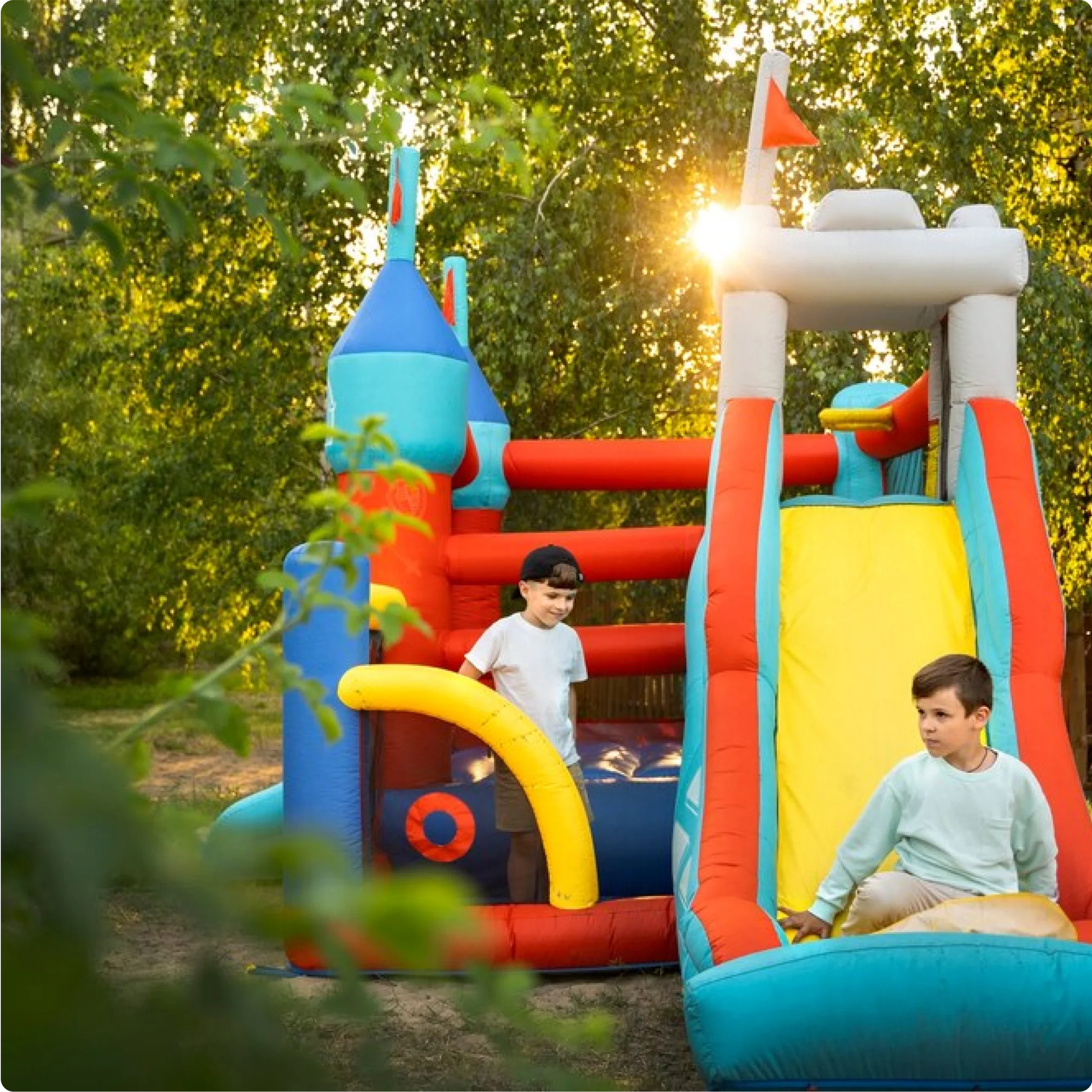
Field day royalty
Ask any elementary school which station rules field day and the answer has not changed in a generation: the obstacle course, undefeated. The format fits the institution perfectly, timed heats slot into class rotations, head to head lanes keep the pace theatrical, and the course absorbs the wildest energy of the day inside padded walls built for it. Teachers run brackets by classroom, principals get goaded into exhibition races, exactly one of which becomes school legend, and the course photographs like an athletic event, filling the yearbook spread by lunchtime.
Our event planning team builds school days around course throughput math as a matter of routine: one mid size course per two hundred students in rotation keeps every grade moving, and the layout guidance ships free with the booking.

From backyard to battalion scale
The category scales with ambition. Thirty to forty foot courses fit suburban backyards and birthday brackets. Fifty to sixty five foot mid sizes anchor school events and church festivals, and the tournament grade monsters, up to a hundred feet of linked stages from our giant lineup, headline county fairs and corporate field days where the course is the event. Some markets stock themed variants, jungle runs, boot camp styles, and holiday skins from the seasonal collection.
Whatever the scale, the geometry rule holds: courses are long and narrow, so the constraint is footprint length plus a start and finish clearing, numbers we confirm against your space before anything is booked.
Pick your course length
Backyard bracket
Birthday sized, big thrill. Fits long suburban yards, races eight to fifteen kids in continuous rotation, and turns a party into a tournament with nothing but a stopwatch app and a juice box podium.
The field day standard
The institutional workhorse: full five stage anatomy, serious throughput, and the visual presence to anchor a school event or festival midway. The most booked course class in every market we serve.
Tournament grade
Linked stage monsters for fairs, corporate championships, and fundraisers selling timed runs. Requires open field, generator planning, and a crowd worthy of the spectacle it creates.
Tournaments, timers, and the bracket that runs itself
A course rental becomes an event program the moment someone writes names on a whiteboard, and we coach every organizer through the formats that work. The double elimination bracket is the birthday gold standard, everyone races at least twice, the finals earn an audience, and the champion’s trophy costs four dollars and confers immortality. Time trial formats suit bigger events, every participant races the clock, the leaderboard updates all day, and the top ten run a finals heat at closing, which keeps early arrivals returning and late arrivals sprinting. Relay formats turn courses into team sports for corporate events and youth groups, four racers per squad, batons optional, alliances temporary.
Fundraisers monetize the same structures cleanly: entry fees per bracket slot, premium timed runs, sponsor banners at the start and finish arches where every phone camera points, and a championship hour that concessions dream about. The operational load stays light, one volunteer starter, one timer, one whiteboard, because the course itself enforces the rules, there is only one direction and gravity handles the disputes. Our crews brief the race officials at setup, hand over lane reset tips, and have watched enough brackets to advise on seeding, which for the record should always place siblings in opposite halves of the draw, a lesson every family event learns exactly once, usually in the semifinals, always with witnesses, and never forgotten by the losing sibling for the remainder of the calendar year.
Why competition beats free play for the hardest ages
Somewhere around age nine, open ended bouncing loses its grip, and the years from there to adulthood are the entertainment industry’s hardest problem: too old for castles, too young for everything else, and armored in the studied indifference that defines the age. The obstacle course is the proven counter, and the mechanism is worth understanding. Competition provides the permission structure that free play no longer offers a preteen: racing is not childish, racing is sport, and sport is socially safe at any age. The same twelve year old who would not be caught deceased in a bounce house will run heats against their friends for two hours, because the frame changed even though the vinyl did not.
Youth groups, middle school events, and camp programs exploit this deliberately, building their inflatable budgets around courses and competitive games rather than open bounce floors, and the attendance numbers reward them. The course also carries a quieter developmental payload: managed risk, physical problem solving at speed, losing publicly and rematching immediately, the small resilience curriculum that phys ed teachers recognize on sight. None of that appears in the rental description, but it is why schools rebook the course annually with budget line stability that other attractions envy, and why the category holds the awkward age demographic no other unit reliably reaches.
Safety at racing speed
Courses invite maximum effort, so the category’s safety engineering assumes it. Every stage lands on inflated floor, walls pad the full lane length, climbs carry grip ladders and enclosed sides, and the parallel lane design exists partly for safety: racers never share a path, so the collision case is designed out rather than supervised away. The rules brief runs two minutes, one racer per lane per heat, feet first on slides, no reversing against traffic, similar sizes race together, and the start marshal’s job is pacing heats so the course never carries more bodies than its rating allows, which is the single number that matters most and the one our crew posts at handoff.
The equipment side runs the fleet standard with course specific attention: seam inspection along the high stress climb and squeeze stages at every setup, anchoring engineered for the unit’s length and the day’s wind, and the same honest weather protocol that governs everything we deliver. Adult racing gets its own note, most mid size and larger courses are adult rated and corporate events use them hard, and the briefing simply adds the disclaimer decades of company field days have validated: warm up first, because the squeeze wall does not respect job titles and hamstrings have long memories. Institutional bookings receive certificates of insurance to spec as standard, with the paperwork rhythm covered on our event rentals page.
The course day, from truck to trophy
A course booking runs on the fleet’s standard rhythm with a little extra length in every step. Delivery arrives early because a sixty foot unit takes a beat longer to position, roll, and inflate than a castle, figure forty five minutes to an hour for the mid size class from truck to inspected. The crew walks the full lane length checking seams and anchors, briefs your starter on heat pacing and capacity, posts the ratings, and hands over a course ready for its first qualifier. From there the machine runs on rhythm: pairs launch, pairs finish, lanes reset in seconds, and the start marshal’s whistle becomes the day’s metronome.
The finish line develops its own economy as the day goes on, spectators accumulate, times get recorded with increasing seriousness, and someone inevitably appoints themselves commissioner of the leaderboard, a role that has never once gone unfilled in the history of our bookings. When the last final is decided, teardown reverses the morning, the crew deflates, rolls, and hauls while the podium argument continues in the parking lot, and the field returns to ordinary grass holding nothing but the flattened rectangle where a championship briefly lived. Organizers get the same closing ritual every time: the direct number for rebooking next year’s date before this year’s inflation fully leaves the tubes, because course traditions, once started, do not surrender their weekend.
What obstacle course rentals cost
Backyard courses open around three hundred fifty dollars for a standard day, the field day standard runs four hundred fifty to six hundred, and tournament grade giants price from the mid hundreds up, all figures all inclusive of delivery, setup, inspection, and pickup in the house style. Per participant, the math embarrasses the alternatives: a five hundred dollar course serving four hundred field day racers costs a dollar and a quarter per athlete for the best hour of their school year, and fundraisers routinely flip the entire cost through entry fees before the finals heat. Bundle economics apply as everywhere, a course plus support units shares one delivery, per the package guide, with the category’s full context in the prices guide.
Calendar pressure peaks with the school year: April and May field day season books the mid size class solid weeks ahead, and fall festival season claims what summer leaves. The backyard class breathes easier year round. Whatever the size, courses reward the same early booking discipline as every headliner, because the school that reserved in March races in May, and the one that called in May hears about it at the district meeting, where the PE department has neither forgotten nor forgiven the year field day ran on borrowed cones.
Frequently asked questions
How much space does an obstacle course need?
Length is the constraint: the course footprint plus ten to fifteen feet of clearing at both start and finish. A backyard course wants roughly 50 feet of usable run, the field day standard 70 to 80, and the giants need open field. Send your longest dimension and we will match the class that fits.
Can adults race the obstacle courses?
On mid size and larger units, yes, most are adult rated and corporate events run them competitively. Warm up first, race similar sizes, and accept that the squeeze walls are democratic. The briefing covers the rest, ratings included.
How many kids per hour can a course handle?
A mid size course processes 100 to 150 racers per hour in paired heats with a volunteer starter keeping pace, which is why one course anchors rotations for events of several hundred. We run the throughput math for your headcount at booking.
Do courses work indoors?
The backyard class fits many gyms, and several mid size models run indoors where floor length allows, anchored with ballast. Winter field days in the gym are one of the category’s best kept secrets, and ceiling height is rarely the issue since courses run long rather than tall until the finish slide. Send the gym’s floor dimensions and we will confirm the fit before your PE department commits the date.
Related resources
Two lanes. One champion. Zero arguments.
Send your date, your space, and your headcount, and we will deliver the course, the throughput plan, the volunteer briefing, and the fastest hour of your event, with the rematch already scheduled.
Start My Race